
Emotional readiness
ready isn’t a feeling. It’s a response
Personal Reflection
I used to think being “ready” would feel like confidence — like I’d walk into practice or a tournament and just know. But that’s not how it showed up for me. The biggest shift happened when I realized I could still be nervous and train like myself.
During the first year of my injury, especially when I was preparing for post-season competitions, I lived with this constant sense of urgency. Like I had to train extra hours to make up for all the months I lost — like if I didn’t, I wouldn’t be ready. It was hard to know when to slow down, and even harder to actually do it. Later, I realized that urgency wasn’t discipline — it was fear wearing discipline’s clothes. My emotions were driving the pace, and my body paid for it.
The first time I truly knew I was ready happened in a simulation match in the room. Not because I felt fearless — but because even after giving up a couple points early, I stayed composed. I stayed patient. I took a breath, got back to my basics, and made smart choices instead of rushed ones. I chipped away, earned my points back, and stayed in control of my mind the whole time.
That’s when everything changed. I stopped chasing a feeling and started building an important skill: staying in control—even when I wasn’t perfect.
Because readiness isn’t confidence. It’s composure under pressure.
The Truth Most Athletes Learn Late
Emotional readiness isn’t “feeling confident.” It’s being able to train and compete without your emotions hijacking your decisions. Most athletes learn this late: ready isn’t a feeling — it’s a response. Return-to-sport doesn’t wait for perfect confidence. You can feel nervous and still be ready, and you can feel confident and still not be ready. What matters is whether you can stay steady when emotions spike—notice what you’re feeling, regulate it, and still execute.
THE CYCLE — WHAT I EXPERIENCED
Phase 1: Relief
I was finally back doing my sport again. It felt exciting, emotional, and motivating. I thought to myslef, “Finally! I’m back!”
Phase 2: Pressure
Once I was back, the pressure showed up fast - internally and externally. I started thinking about proving myself, keeping up, making up lost time. I though to myself, “I can’t fall behind.”
Phase 3: Hyper-awareness
My body became loud. I noticed everything. Every step, every contact, every weird sensation felt magnified.
Phase 4: Frustration
I grew tired of thinking about it. Physically, I was doing the work, but mentally I felt drained by the constant monitoring. I thought to myself, “Why do I keep feeling this way?”
Phase 5: Confidence Spike
I had a great practice. Movement felt automatic. This was usually the phase where I wanted to skip steps because I finally felt free. I thought to myself, “I feel amazing, I can go all the way.”
But… this is where the rushing began.
Phase 6: Fear Spike
Fear often showed up as a trigger: a weird rep, contact, fatigue, speed, a near-miss, or even a bad day outside the sport. My mind reacted like it needed to protect me, even if nothing was actually wrong. I thought to myself, “What if I tear it again?”
Phase 7: Settling
Over time, the swings grew smaller. I started training without negotiating with my injury. My sport began taking up more space in my head than my body did. At that point, I felt like I was simply training.
The Emotional Cycle of Return
The return isn’t a straight line.
One of the most frustrating parts of coming back is thinking you’re “past it”… and then having a day where everything feels weird again. That doesn’t mean you’re regressing. It means you’re normal. Returning to sport isn’t a smooth climb — it’s more like bouncing between a few common phases as your body and nervous system relearn what “safe” or “normal” feels like.
Progress isn’t the absence of bad days. Progress is recovering faster when they happen.
Most athletes don’t struggle because they feel fear — they struggle because they interpret fear as a sign they’re not ready. But in reality, different phases required different things for me:
If I was feeling pressure → I needed boundaries and a plan.
Pressure makes athletes rush, prove, and ignore signals. A plan keeps you honest.If I was feeling hyper-aware → I needed predictable reps and control.
This is a good time to slow things down and train with intention — clean movement, clear goals, and structured progress.If I was feeling confident → I needed discipline.
Confidence is great, but it can trick you into rushing or skipping steps. Discipline protects your comeback when you feel “good.”If I was feeling fear → I needed a reset protocol, not a shutdown.
Fear is normal. The goal isn’t to eliminate it — the goal is to shorten spirals and create faster resets so you can keep building trust without letting one moment derail the whole session.
The Nervous System Check
GREEN / YELLOW / RED — THE SYSTEM I BUILT FOR MYSELF
One of the biggest things that helped me during return-to-sport wasn’t a new exercise — it was learning how to evaluate my nervous system the same way I was evaluating my knee.
My PT team would talk to me about how the body doesn’t just heal physically — your nervous system has to relearn safety too. They’d point out things like guarding, bracing, hesitation, or how I’d get tight after one weird rep. And the more I learned (and researched), the more I realized I needed a simple way to check in with myself in real time — something I could use before practice, during live, and even on competition day.
So I created a system for myself based on researched self-evaluation approaches athletes use to track arousal, stress response, and nervous system functioning: Green / Yellow / Red. It became my dashboard. Not to overanalyze — but to stay honest and train smarter.
My goal wasn’t to force myself to feel “good.” My goal was to recognize my state and make the right decision from it.
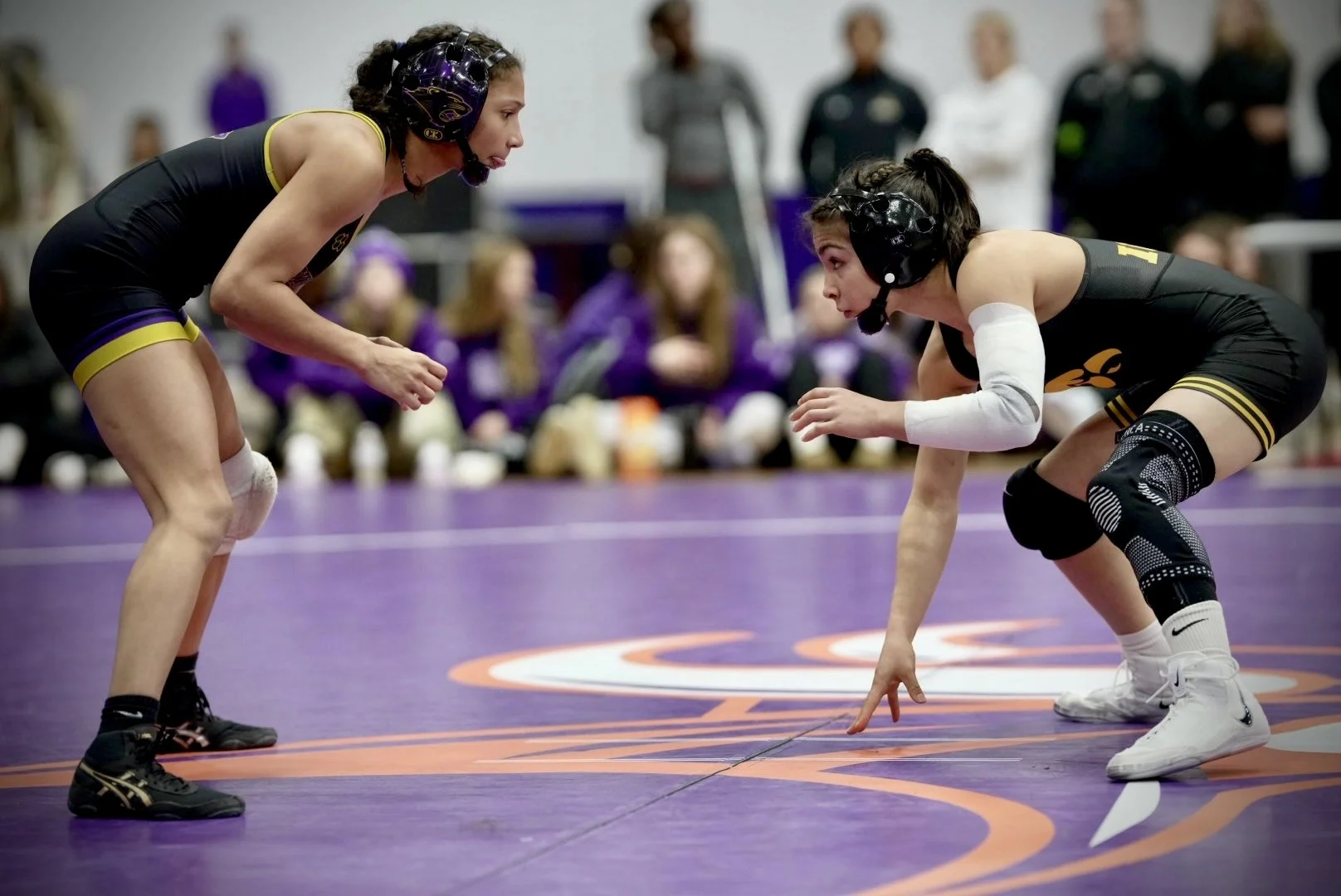
Green Zone = Ready
This is when my body feels online and my mind feels present. I’m not thinking about my injury — I’m only thinking about wrestling. There might be nerves, but they’re normal. They don’t control me.
What the Green Zone felt like for me
my reactions were automatic
I could move fast without “checking” my knee
I bounced back quickly after mistakes
I felt aggressive without being reckless
What I did in the Green Zone
raised the chaos: faster pace, harder goes, more live
trained like I was preparing to compete
focused on execution, not monitoring
My Green Zone intention
“Let it fly.”
Photo by Joel Valencia
Yellow Zone = Tight / Guarded
Yellow was the most common state early on. Nothing was “wrong”, but my body was cautious. This is where I’d feel extra aware of my movement, more controlled, more stiff. My PT team would call it out when they saw it: subtle guarding, protecting, or hesitation.
What the Yellow Zone felt like for me
I was scanning my body more than the sport
I hesitated on certain exchanges
I got tight and tried to control everything
I could still train, but I needed structure
What I did in the Yellow Zone
kept effort high but lowered chaos
focused on predictable reps and clean technique
slowed things down with intention (positions, short sequences, controlled live or spar)
My Yellow Zone intention
“Smooth and controlled.”
Red Zone = Hijacked
Red was when my nervous system got triggered — sometimes by contact, fatigue, a weird sensation, or just a bad day. In Red, it wasn’t just fear. It was my body reacting like it needed to protect me. My technique would change, I’d compensate, and one moment could start a spiral if I let it.
What the Red Zone felt like for me
panic or freezing
I couldn’t stop thinking about my knee
my movement wasn’t automatic — it was guarded
one weird rep could hijack the rest of the session
What I did in the Red Zone
I didn’t try to “push through” blindly
I reset first, then re-entered if I was ready
I stepped down chaos and emphasized control
I often needed to prioritize rest and recovery before stepping back on the mat.
My Red Zone intention
“Reset, then re-enter.”
Note: I only entered these zones during my return to the mat, after being officially cleared by my care team. Your timeline will look different — make sure to work with your PT, AT, or physician to determine what's appropriate for you specifically.
Personal Note About Hyper-Awareness…
I felt this phase almost constantly—especially during those first few practices and matches back. I was hyper-aware of everything: my foot placement, my hands, my body positioning, even how I was moving my opponent. At the time, I thought it was a great thing. I wanted to live in that phase as much as possible because it made me feel in control.
What I didn’t realize right away is that hyper-awareness can be a double-edged sword. In the beginning, it can protect you—because it forces clean movement and intention. But if you stay there too long, it can turn into overthinking. And overthinking is where hesitation starts.
My goal wasn’t to get rid of hyper-awareness. It was to use it as a bridge—long enough to rebuild trust and precision, then gradually return to automatic movement where I was reacting, not monitoring.
Challenge — Build Your Own Readiness System
Come up with your own system to determine your readiness. “Ready” isn’t a single feeling, and it doesn’t look the same for everyone. The point is to figure out what your version of ready feels like—because at the end of the day, only you can truly evaluate what’s happening in your body and your mind.
Here’s how I’d approach it:
1) Define what “ready” feels like for you (in real terms).
Not “confident.” Not “good.” Be specific.
What does your body feel like when you’re ready? (loose, fast, stable, fluid)
What does your mind sound like when you’re ready? (quiet, focused, aggressive, present)
2) Pick 3–5 readiness markers you can actually observe.
Examples:
I’m not thinking about my injury during live
I react automatically instead of hesitating
My movement stays clean under fatigue
I bounce back after a mistake instead of spiraling
I can increase intensity without losing control
3) Create your categories (make it yours).
You can use Green/Yellow/Red — or create your own names.
Examples:
Locked In / Tight / Hijacked
Free / Guarded / Overloaded
Go / Build / Reset
4) Define what each category means for you:
Examples:
When I’m in my “Go” state, I can raise chaos.
When I’m in my “Build” state, I need controlled reps and intention.
When I’m in my “Reset” state, I need a quick protocol—not a shutdown.
Your goal isn’t to feel perfect. Your goal is to know what state you’re in—and make the right decision from it.
Setting Intentions
PERSONAL REFLECTION
One of the biggest things my coaches emphasize with our team is setting an intention before practice. Not just “work hard,” but a real purpose — something you can come back to when the room gets chaotic, when you get tired, or when your emotions start driving the pace.
During my return, Lauren reinforced this constantly. There were days she gave me real autonomy — she’d let me choose what I wanted to do within my limits. But before I started, she’d ask me: “What’s your intention for today?” Not to control me, but so she could guide me better. So she could match my rehab to what I needed mentally and physically, not just what the plan said on paper.
That question forced me to be honest. Was I training to build - or training to prove? On the days I set a clear intention, I left practice feeling in control. On the days I didn’t, I usually let the environment decide for me.
Setting intentions became my way of staying disciplined without losing the joy of being back. It gave my training direction — and it gave my “comeback” a standard I could actually measure.
These were some of the intentions I set before stepping onto the mat again:
“I will train with control.”
“I will chase clean reps only.”
“I will stay present.”
“I will monitor my load so I can continue building tomorrow.”
I will leave with momentum.”

Know When To Get Support
STRATEGY, NOT WEAKNESS
I recommend you get support if:
fear is increasing week-to-week
you’re avoiding a movement for 2–3 weeks straight
you’re freezing or panicking regularly
your injury thoughts spill into daily life constantly
you feel pressure to hide what’s happening
** Remember, getting support isn't a weakness. It’s an advantage. Don’t be afraid to reach out to your support system and get what you need to put yourself in a position for success.